
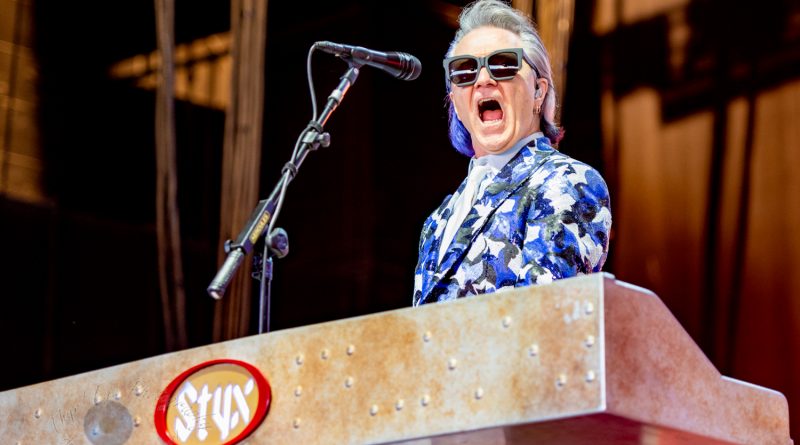
Interview: Styx’s Lawrence Gowan Talks About Blues Hockey, Song Structure, AI and More Ahead of their Show Monday

WHO: Styx and Chicago
WHEN: Monday, August 24 @ 7 pm
WHERE: Hollywood Casino Amphitheater
TIX: Available now HERE
–by Tom Schmidt
Tom Schmidt – Midwest Rewind: I’m Tom Schmidt of Midwest Rewind and I’m here with Lawrence Gowan, keyboardist and singer for the group Styx. The band will be performing at the Hollywood Casino Amphitheater on Monday, August 24th. First, I do want to thank you for the interview and getting to meet you and taking the time to be interviewed.
Lawrence Gowron: Well, it was great chatting with you, Tom. All the best. We’ll see you in a couple of days.
Tom: Short interview, man of few words. So tonight you’re performing, I think, in Oklahoma, is that correct?
Lawrence: That is correct. We are in Oklahoma. I’m looking out the window right now, Tom. Apparently this is the largest casino on planet Earth, but I heard someone last night explain that because I know it doesn’t look any bigger, the footprint doesn’t look any bigger than the ones that we’ve played in Las Vegas, but apparently someone said, I overheard someone on the floor said, no, we have the most, I think he said slot machines, which qualifies us as the biggest ever. So, congratulations. Most of all, what’s important is that they have Chicago and Styx playing here tonight for another sold out show on this tour, he said completely and modestly. It’s been a fantastic tour, and this is an absolutely beautiful venue. We did play here back in 2015 before they had built this venue. I think we played outdoors.
Tom: Okay.
Lawrence: They had kind of a makeshift thing, which is great, but oh my God, this place looks spectacular. So, looking forward to tonight.
Tom: Good, good. Yeah, it’s been a long tour, I think, too. I think, did you start maybe back in February or so? Off and on?
Lawrence: Well, you know, here’s the thing. We play about 100 shows a year. And that means, you know, we break the tours up into like separate segments. So, what we were doing in February, we started with our residency in Las Vegas at the Venetian. And then from there, we begin to play, you know, more arenas or theaters throughout the spring. And then the big blockbuster summer tour is usually with us playing the amphitheaters with a partner. A couple of years it was like Foreigner or REO Speedwagon or, you know, some various bands.
Tom: Well, I was at the concert last year here in St. Louis when you were with Don Felder and Kevin Cronin.
Lawrence: Yeah.
Tom: And really enjoyed that concert.
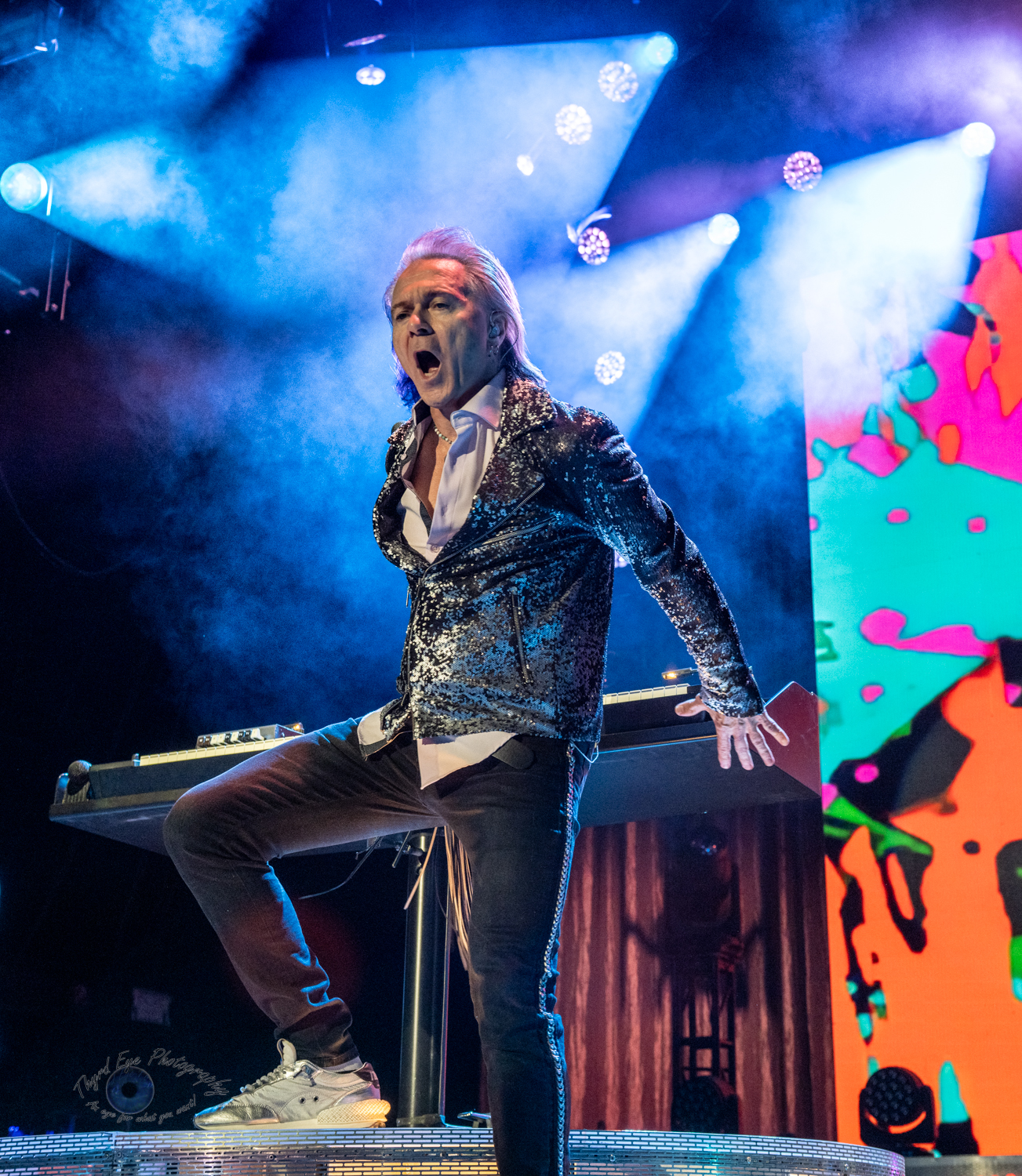
Lawrence: Oh, thanks for saying that. I love that venue. That’s one of the first amphitheaters that I ever played with the band when I joined them 27 years ago, and it was called River…
Tom: Riverport.
Lawrence: Back then, River… Riverport, exactly. Right. I remember it was Riverport. And we wound up doing a live album from that amphitheater called Arch Allies, which is us and REO Speedwagon.
Tom: Correct, right.
Lawrence: That was really the beginning of having a double bill of two, you know, kind of legendary classic rock bands that tour together in the summer and give people a real variety and a real bang for their money. This year, I have to say we have never toured with Chicago beforehand, and I asked JY and Tommy, have they ever done shows with them, you know, in the ’70s, and have they had said, “no”. So, I think that this has been really, really embraced by the audiences. I think they’re drawn to the fact that it’s two iconic names side by side and two very contrasting styles of music, and yet both bands being from the Midwest.
Tom: Right. Well, and you had mentioned, I mean, REO Speedwagon obviously is from Illinois, and Styx and Chicago are all from Illinois as well. So, we’re very familiar with all of them here.
Lawrence: Yeah, I know from JY, and Chuck in their Styx history classes that they continue to give me, that St. Louis was one of the first cities that ever really embraced Styx to the degree that they have. And it’s just been a great relationship ever since.
Tom: Well, I’m going to skip to one of my questions. I wasn’t going to lead off with this, but since we’re talking about it, because that Styx has had a solid connection with St. Louis and they’ve played over 40 times: Super Jam at Busch Stadium, the Arena, Fox Theater, the Pageant, the VP Fair, and of course Hollywood Casino Amphitheater. So why do you think the connection is so strong?
Lawrence: You know, those are things that are somewhat inexplicable. I just think that there was something in Styx’s approach to how they approached progressive pop rock, I guess you’d call it, back in the ’70s that just clicked with St. Louis. Back then, as well, the radio was such a driving factor. And I think the radio stations there really embraced Styx quickly. St. Louis, Kansas City, there were a couple in Salt Lake City. Those were some of the first places that really began to play their records in a heavier rotation and audiences just, it just connected with them, you know, that’s just how music works. You’re exposed to it and it connects with you, it just, it becomes like an avalanche of acceptance, and people follow the career and now I’ve followed Styx for 54 years.
It’s quite remarkable. I mean, you think of the fact that the song “Crystal Ball” came out in 1976, this is the 50th anniversary of that, and we see multiple generations singing that song when we look out at the audience. So, and it’ll be the same with St. Louis, where very likely that song probably received some of its first airplay in its initial push. And here we are half a century later and that the song is still very vibrant and alive in people’s minds.
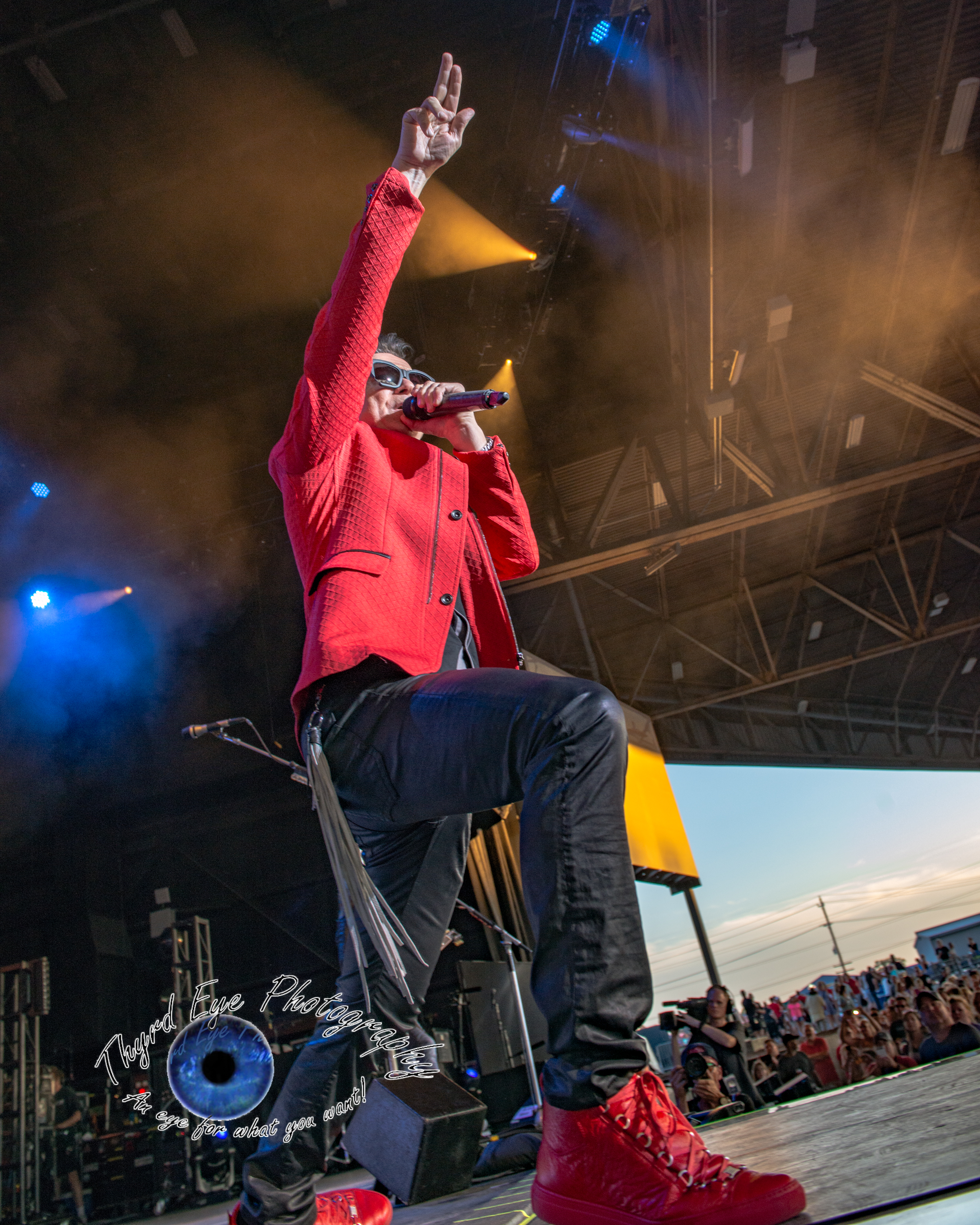
Tom: Yeah, it’s unbelievable. It is. I’m going to ask another somewhat similar question and then I’m going to get back to my original questions. So, you guys have been in St. Louis many times. Is there any favorite place that when you’re here you like to go visit or go eat? If you have the time, obviously.
Lawrence: Well, for me, it’s three places. One is I’m still very much enamored with the Joplin House. You know, Scott Joplin’s house that has been preserved in a historic place there in St. Louis. Luckily the last couple of times we’ve been a good walking distance of it and I’m able to go there and I love his ragtime, the history of ragtime. I happen to be gathered, drawn to that music and his whole connection to it, and he was the driving force of it and St. Louis was at the very center of that musical shift. That happened in North America, so I’m drawn to that.
I’m drawn to the Arena there, of course, ’cause I’m a hockey fan, and a fan of the St. Louis Blues. I’ve followed them since 1967 when they came into the league. You know, I’m from Toronto, so they were one of the first expansion teams. And quite honestly, just as a regular tourist, I love the Arch, because I love, first of all, that album cover I mentioned to you, Arch Allies. I just love it, it’s a very unique gateway to a city. You know, I don’t know of any other city that has a similar monument as that. I enjoy walking around that area, going by the Cardinals baseball stadium. I’m a person that just likes to walk through cities and try to drink in what the local culture is. And what I have found being around the Arch there by the river is I haven’t exhausted the enjoyment of just that simple pleasure.
Tom: So you mentioned about Scott Joplin and obviously with you being, you know, a keyboardist and a pianist, you are classically trained on the piano, as I understand. And so, what was that like growing up and who is your favorite classical music composer?
Lawrence: Oh, great question, great question. So, growing up, you know, I started taking some piano lessons when I was like 10. And, you know, I’m still pretty good at it. But then, when I was about 14 and in high school, the progressive bands that came out were Yes, Genesis, Emerson, Lake, and Palmer, and then obviously Elton John and Freddie Mercury from Queen. They all kind of really captivated my imagination as to how a keyboard player could be a front man. And I noticed that the connecting thread from most of those guys, particularly (Rick) Wakeman and Elton, was that they were trained at the Royal Academy of Music and Royal Conservatory. And I just thought, you know, if I’m going to do this, my chops have got to get a real update. So I thought I’ll go to the same kind of way of learning, and I kind of just fell in love with playing classical music, and trying my best to interpret the composers, and so at the end of high school I spent two years just doing nothing but going to The Royal Conservatory in Toronto. It’s the same thing to have royal in front of it. The Queen. The Queen approved it, right? So, I spent a couple of years just really deeply embedding myself in that.
I wound up getting a little degree in classical piano performance, but always, quite honestly, with the intention of directing that extended the musical vocabulary, I guess you’d call it, into the songwriting that I wanted to do to play in a band. I wanted to be like Rick Wakeman, you know, or Tony Banks or the guys that I just mentioned. And in order to feel that I could kind of rise to that level or as close as I possibly could, then I’d have to kind of follow a little bit of the same path that they did and really delve into classical music. And I still do that every day. I mean, right now I’m learning a piece, that famous piece by Erik Satie. I’d say he’s my favorite composer, it’s so hard to choose one. It would be probablya tie between Beethoven and Tchaikovsky, somewhere between those two. But that’s a terrible disservice to Debussy and Mozart, which are the ones that I love as well.
But I’m drawn to Beethoven because I’m still so enamored with his life story. Just what a force of nature he was and what music did to that guy’s life. I’ve been a couple of times to Bonn, Germany where we played there. I’ve gone to his birthplace. His house has been preserved, much like the Scott Joplin thing I just told you about. But this is actually the house where he was born. And when I think about the drive that it must have taken for him to be a musician of that caliber back then, and the tragedy that turned into one of the greatest things with him losing his hearing and having to tread the path that he did and yet stay devoted to music and what it can do to a person’s life. I’m just so intrigued by that story that whenever I listen to a Beethoven piece, all of that comes into the into the equation. So, I’m really lifted by that. Secondly, I’d say Tchaikovsky had a similar sort of story in that he had to struggle with being a person living in Russia back then or, Ukraine making it’s claims to him now, and I think that’s probably true. But he had to struggle with personal things as well that were really tough for him to get over. And yet the music just has lasted so long and still moves people to this day. I find that to be just one of the greatest things you’re crossing centuries, and yet still so connected to these musical geniuses.
Tom: Yeah, and many of the classical composers reach that. I mean, that’s what keeps them around is what they’ve done for music through the centuries.
Lawrence: Well, they moved it forward which is I guess why in the rock era, which dominated the last half of the 20th century, I continue to be drawn to it as much as I love all forms of it. I really do, I mean from the most basic ’50s rock and roll right to the present day, I like all of it, but I’m particularly drawn to what happened during that progressive rock push of the ’70s because they were doing similar things that composers were doing, trying to push it, trying to advance it forward and make it go into areas that were heretofore unexplored and just see how far they could push the equation of what rock music could be. So, I see similarities there.
Tom: Yeah, and you mentioned Beethoven earlier too. In music theory classes, you’re taught not to bunch the bass notes together. And what does Beethoven do? Bunch all of the bass notes together.
Lawrence: Exactly, yeah. That’s great that you know that. Yeah, the one piece. I’m always struggling with the first part of the “Appassionata” thing. That’s right, he does exactly that. He goes, like, I got my little keyboard here. I always got it set up in the room, but yeah, he’s down in the bass, so I like, hang on. Way down there, go ahead.
Tom: Yeah, he decided to break all the rules.
Lawrence: (Plays a couple of measures of Beethoven’s “Appassionata”) Yeah. Yeah. I can’t play this. Anyway, I’ll blame it on the piano, not me and my fingers. Yeah, but he’s way down there backing away and yet coming up with something that … I always picture in that little section that the storm is gathering for the explosion to come out of it and I love that I find that in the best of rock music as well, it goes into areas it’s supposed to and comes out with something really moving.

Tom: You’ve been part of Styx for 27 years. What do you attribute to your longevity with the group?
Lawrence: Oh, my longevity. Well, first of all, I’d say after having a long solo career, I was on Columbia Records from 1982 until 1999, and I had all of that kind of in my background, I guess that was really what caused them to open the door to me to come into this group. I came in, I basically came in in the corner office, you know what I mean? The building was already built. I just had to help uphold it for a few more years. I remember originally J.Y.’s goal was to make it last five years. He thought, you know, with all of the cultural references to Styx popping up in movies like Adam Sandler’s Big Daddy and all that, the timing is right to kind of see if we can extend the life of Styx for another five years. That was in 1999. So, we’re looking at 2003 as being the target. But not knowing that even at that time, not really realizing that the longevity of classic rock was going to continue on, that the music really had legs and we kind of didn’t know it.
In some ways we doubted that it had that kind of an impact. So basically, I think with committing to playing 100 shows a year with the band, the fact that we get along so well, and the fun that we have obviously it somehow is translated to the audience from the stage because they seem to be having the time of their lives when we’re playing. And basically, the other musicians in the band being of such a caliber that I have to keep up with them, those are the things that I think have kind of helped me to stay in good membership standards.
Tom: So, you mentioned that you kind of came in through the corner office. How did you end up becoming a member? I mean, you didn’t fill out an application, or I mean, did you know somebody or they called you, you called them or how did that happen?
Lawrence: So, in 1997, I had a live album out, which is, curiously enough, it was a solo piano record. I’d done a tour where I just toured for an entire year, a year and a half actually where I just toured without my band and played a big, long series of solo shows and recorded them. And I put a live record out that year and it had a song on there that got into the top ten immediately in Quebec and funny enough that’s where a promotor called about three weeks before Styx were to play in the new Montreal Forum and said “I know you haven’t opened for anyone in Canada for like 14 years, but the new Montreal Forum has been built. You’re touring solo piano. How would you feel about opening the show for Styx?” And yeah, the last time I opened for anyone it was Supertramp and it was like early ’80s. And I just said, yeah, you know, I think it’d be great because I get to play the new building and it’s not my band, it’s just me just doing the piano stuff. And on that night, of course, the audience recognized these songs.
I had several top ten songs, and multi-platinum records. And so, they were singing them and the guys in the band took note because we heard the crowd really going for this opening act and then multiple encores and stuff like that. And when I came off stage, Tommy Shaw just came up to me and said, “Nobody’s ever had an encore that opened for us ever”. So, he said, “Let’s stay in touch because I think we should do more of this in the future”. So, when they called in early ’99, that was my assumption. I thought, I guess they would like me to come and open some shows. You just move a piano on stage and off. That’s the end of the opener. But I kind of thought to myself, I got to tell them I don’t want to do that in Canada. I’d love to do it in the United States because my records were never released there. And so I said, “Well, yeah, I’d love to open my…” “Would you be interested in…” And I said, “Yeah, I’d love to open shows for his…” He said, “Actually, no. Would you be interested in joining the band?” And I was like, “Oh, let me think about that. Give me an hour”. I went and got a copy of Grand Illusions, listened through just to see, can I hit these notes because I’d never really checked that out with Styx in the past, but I called them back in an hour. I said, “You know, I can sing these songs”. And I really liked, I really enjoyed their show. I’d never seen them until ’97. And I remember seeing them, I was super impressed with how good they were as a live act. And I just suddenly felt, Yeah, Why don’t I try it out for a while? Let’s see what happens if I join the band.
Tom: And 27 years later.
Lawrence: I know. The experiment continues.

Tom: Right. So, what keyboard or keyboards do you use in concert while touring?
Lawrence: Oh, sure. Do you play keyboards yourself, Tom?
Tom: Yes. Yeah, I’m a classically trained organist, actually.
Lawrence: Are you really?
Tom: Yes.
Lawrence: Oh, great. You know what? In Beethoven’s house in Bonn, they have the organ manuals, the organ… Yeah, yeah, I think it was, I can’t think it was like three…
Tom: Manuals.
Lawrence: Yeah, that he actually played when he was like 12 years old in the church.
Tom: He called the organ the” king of instruments”.
Lawrence: It kind of is.
Tom: It’s the first, it’s the world’s first synthesizer.
Lawrence: It is, absolutely. Do you like playing churches and stuff like that?
Tom: Yes, yeah. I was a little disappointed when you said Bach wasn’t your favorite composer.
Lawrence: I’m saying the only reason he wouldn’t be is because I wasn’t all that good at playing it. I’m better at stuff that requires some bashing with Beethoven. Like, I remember when I did my… Okay, now I know that you play all… It’s like my piano teacher, the conservator, he noticed right away, I’m going to get this. He goes, “You got to play pieces that other people don’t play, and you know, you’re kind of a basher, because if… rocked right so here play Beethoven, Liszt, Berlioz”, and what was the other one, uh, and Shastakovich and
Tom: Rachmaninoff?
Lawrence: No I didn’t do Rachmaninoff funny enough, but no, Gershwin was the other one. Okay, well you know because I had a lot of people at the conservatory who wouldn’t have the kind of, the built-in vernacular about blues you know what I mean? And because there’s a lot of blues notes in Gershwin I like to slide into them and all that sort of thing. It was foreign to some of the better players at the place than I was. So, he picked pieces that were kind of, Bach is mandatory, so I probably played the simplest one I could get.
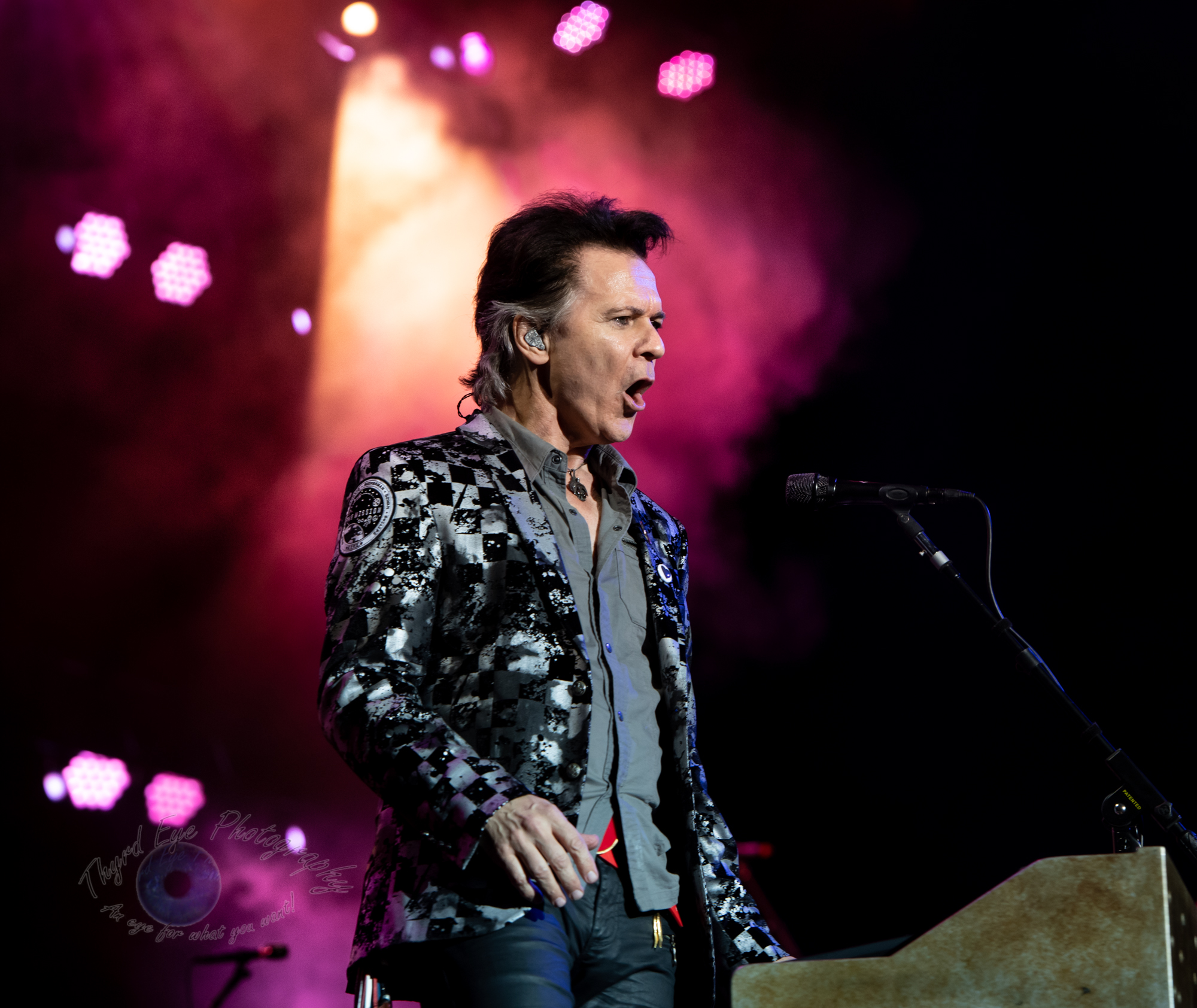
Tom: So, what keyboards do you use?
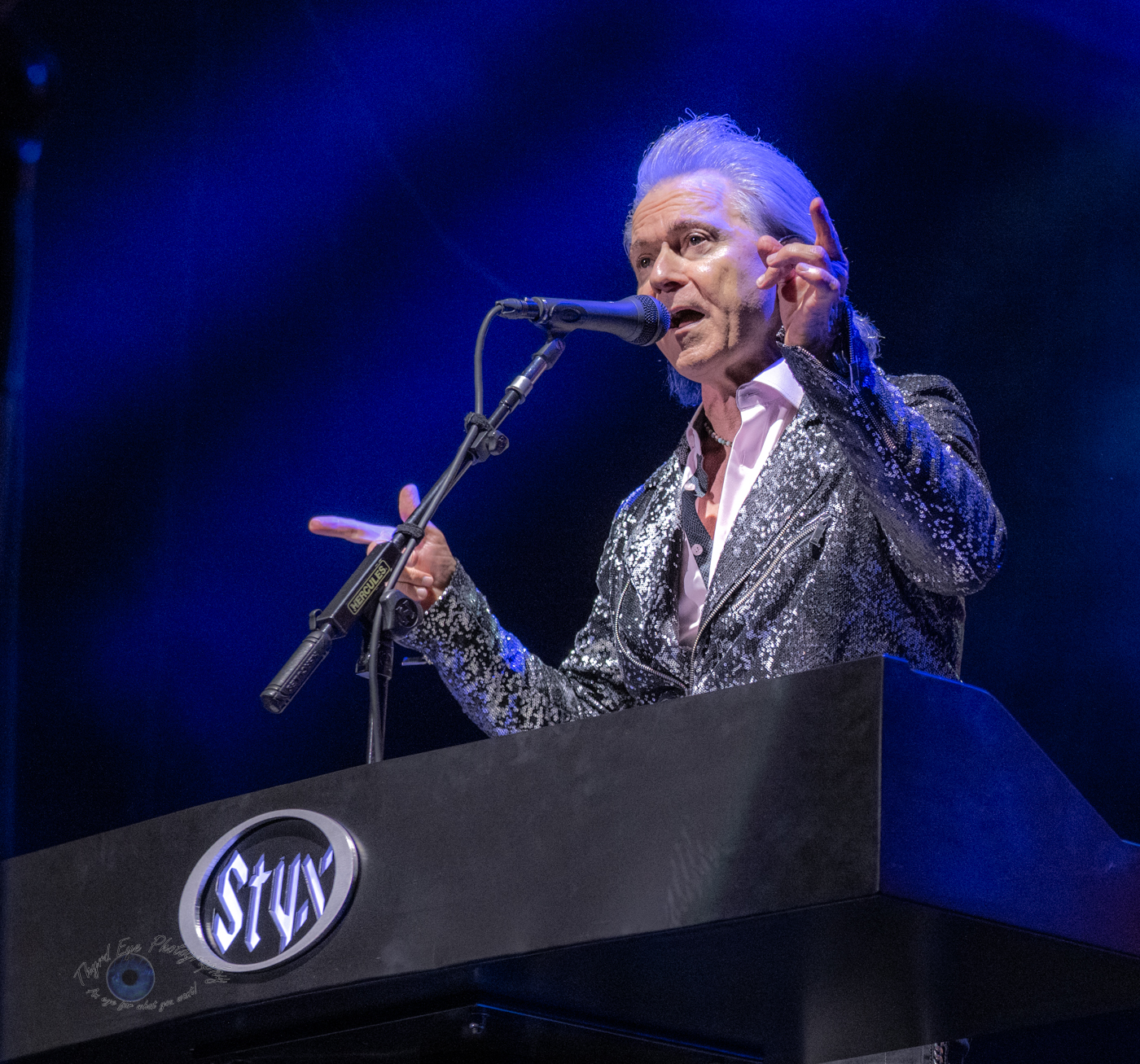
Lawrence: Yeah, so, I play a Roland RD-800. But I still do solo shows in Canada wher I play an RD-2000, but the Styx keyboard that I play is an RD-800 and that’s MIDI’d to, I use that piano sound and it just kind of sculpted it myself. And then that’s MIDI’d to a Roland Jupiter XM, which does all the synth sounds. And then it’s also MIDI’d to a Roland VK. That’s my whole setup, it’s those three things. And then, what if I have to fire a sample, like the big beginning of “Mr. Roboto” and stuff like that? Or “Too Much Time on My Hands”. That’s just on a USB key that I have in the Roland. Okay. So I’ll fire that off and then go into like, say the start of “Too Much Time on My Hands”. I’ll fire that sample and then just go into the song from there. That’s my entire setup. It’s really very simple. A lot of people think it’s quite complicated and it’s not. It’s really quite simple.
Tom: So, is that weighted keys and touch sensitive then?
Lawrence: Yes, they’re touch sensitive weighted keys, yes.
Tom: Oh, good.
Lawrence: So, I play just the one keyboard for the entire show. I just find that if it feels like a piano. Right. I’m probably going to play it more precisely and not have to change my technique by jumping from one keyboard to another. I enjoyed it back in the days when I did that. I was really terrible about it, but to analyze the performance, I wasn’t as good at doing that as just playing a straightforward piano keyboard. And so, when the weighted keyboards came out, the first one being the Yamaha GP-70 back in the late ’70s, which was basically a real piano, but just without the soundboard, if you remember. It was the one that Tony Banks played in Genesis. Once I got into playing that, I was like, I really don’t like jumping to the synth keyboards.
Tom: Right, because you don’t have to work as hard. Your fingers are still wanting to work hard.
Lawrence: Yeah, that’s kind of it, I mean, and you’re playing pipe organ, it’s like, that has a specific, it has a specific touch to it.
Tom: Sure.
Lawrence: It’s not quite like a synth at all, there’s still some push in there. And you know what I mean? Yeah. So once your fingers have become accustomed to that, it’s nice to stick to that because it is just like getting on this, it’s like the same bicycle, it takes the same kind of effort to make it work and whether you’re playing a light little flute sound or you’ve got all the big, what do they call them, diapasons and all those things all opened up, at least you’ve got the same temperance coming from your fingers, going through your arms, et cetera. So, I like the consistency of that.
Tom: Yeah, even jumping from the organ to the acoustic piano is a big difference too.
Lawrence: Yeah, it is.
Tom: Or back and forth.
Lawrence: It definitely is. It’s different key depth. The key bed is a different depth and everything. If you practice it enough, you get a depth enough at it, but I just love the idea of staying on one keyboard. That’s kind of just, okay, I got to talk to this guy this way.
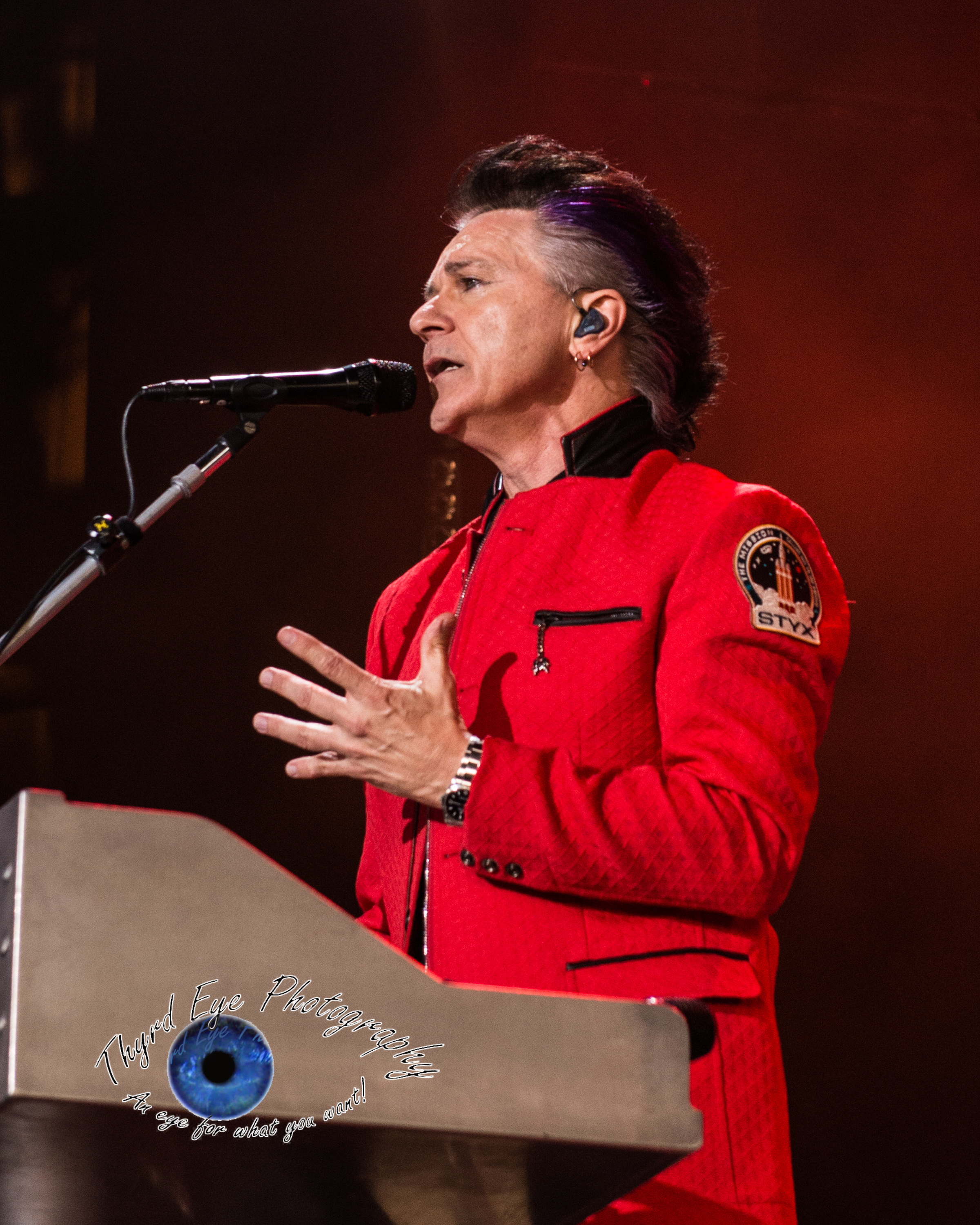
Tom: So, when you perform a song live, like “Come Sail Away” or any other song that’s multi-layered and it’s got like the ostinatos and then you’re adding more stuff on top of that. How do you…you can sequence that in the recording studio, but how do you do that live?
Lawrence: It’s actually really simple. You know how you have several manuals on the organ? You have two, three, four, sometimes 5? Okay. So, all I’ve done is I take the 88 keys and I split them up.
Tom: Split it, uh huh, okay.
Lawrence: On the keyboard, right? So, let’s say in the front of “Come Sail Away”, I’m playing the piano part, right? Because it’s a straightforward piano. When it kicks off to the rock section where the guitars take over, I simply advance to the next program, right? Which I have the keyboard split up into the left hand that is the pad, that kind of sizzly pad. And in the right hand, I now have the kind of hornish flute part that plays that solo. And then at the very top of the keyboard, I have a sound effect for the big crash that happens at the end of that session, the whole synths like crashing down.
Tom: Right, right, okay.
Lawrence: Yeah, so that’s just on a sample, and then I just play along with that, I play a chromatic scales going down kind of, you know, one hand over one chromatic scale after another, and they’re all kind of blending into each other, causing that cacophony, and then that goes back into the guitar section. So, it’s the same for all the songs. It’s like if it’s piano at the top of the song, then I’ve just got a straightforward piano sound, and then I just advance to a split keyboard. The hardest part is just playing it enough times to remember, well, okay, this, what do I say, the organ goes from A0 up into, you know, C3, let’s say, right? And then from C#, from C# 3 up to, you know, E4 is going to be this little solo sound. And then from F4 up to the top of the keyboard, it’s going to be this other lead sound. You see what I mean? It’s memorizing each song and where on the keyboard that sound exists.
Tom: Right. And I, you know, it’s just practice too, like having that left hand do that ostinato pattern, for instance, in “Come Sail Away” and then have that right hand come in with a different melody and whatnot.
Lawrence: That’s right.
Tom: Okay.
Lawrence: It’s just practice. It’s just practice.
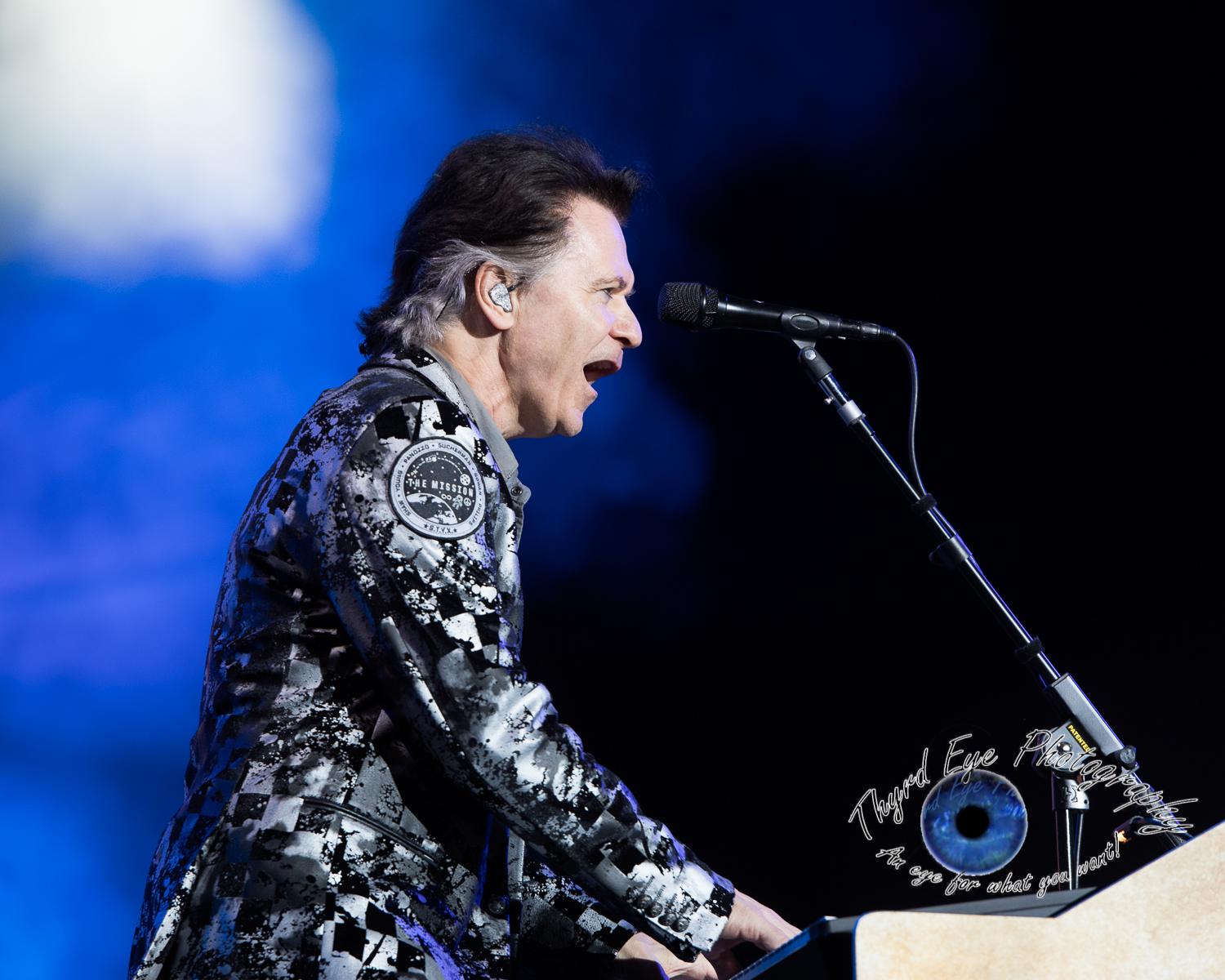
Tom: Yeah. When you compose a song, do you start with the lyrics or the music or do you start with a motif or a style or what do you do?
Lawrence: You know, it’s never the same twice, but generally speaking I’m looking for initially a chord sequence that suggests a melody, okay, a chord sequence that suggests a melody, and then that melody suggesting what the subject matter should be, and then that subject matter being distilled down to, well, let’s try this title. So, I’ll give you an example: especially well, because in the band, usually it’s multiples of us co-writing. So, on our latest album, there’s a song called “Build and Destroy”. So, I had that that the main keyboard section of the song and the melody was already there, not the bridge, but basically just not the bridge of the song, but the main keyboard part and melody. I had that and then I just thought, Oh, I like I like that the idea of this melody suggests a title like “Build and Destroy”. So, when I played it for the other guys, I’m like, Okay, here’s where it’s at. I played the keyboard thing, and I said, I think the title I have so far is “Build and Destroy”. So, then Willie Evankovich, who’s the guitarist and the producer of the record, and then Tommy Shaw… They go from there and go, “Hey, what if there was a line in there that said this”? You know what I mean? And then you begin from that point to co-write this piece until it comes to a final moment where you actually, instead of tearing each other’s hair out, you’re looking at each other kind of going, “I like that”. So, that’s the co-writing thing. If I’m doing it on my own, it’s pretty much the same thing except for probably more hair loss.
Tom: So, I mean, it could be either way. It could be like, I got this melody or this kind of chord progression, or it could be, man, these words, I kind of like these words and see what I can do with putting music to that. It all just depends.
Lawrence: You know what? I love when guys can do it that way. Like Elton John did it that way. He’d take a Bernie Taupin lyric and that would suggest where he would go with it musically. I’ve never been great at that. I can sometimes take a little phrase, but that’s more rare. I’ll take a little phrase and a little melody will suggest itself based around that phrase, but then I’ve got to build out the entire song around it and come to think of it quite often in so doing, that initial phrase might even disappear. It might not make it past the ultimate… To me, the ultimate gate is what is the melody? What does this melody want to do? What does it make me want to say? How does it affect me in an emotional way and follow that? That to me is the ultimate arbiter is where does this melody want to go?
Tom: So, on “Build and Destroy”, what’s the meter signature? Because I’m listening to the, you know, your left hand part and it’s very, it sounds very syncopated.
Lawrence: It is very, it is extremely syncopated.
Tom: But 4/4 can be syncopated too, so.
Lawrence: It’s still 4/4
Does that sound good? (Plays the bass line of “Build and Destroy”) Can you hear that? Yeah, yeah. Okay, so is this. (Adds the right-hand part) That’s very sync, right? Yeah. The hard part is that this melody, this melody. Right? (Plays the vocal line) It’s playing the syncopated under. Oh, sorry. I know that sounds like I’m playing on the beat in my left hand, but I’m actually, it’s actually syncopated and the rest of the band, the bass and the drums are filling in that, the downbeat. And my left hand’s actually playing the offbeat.
Tom: Right, right.
Lawrence: It’s funny you bring that up. That was the trickiest part to put together for me for live.
Tom: Yeah.
Lawrence: Because in the studio it’s fine. You get your left hand, you’re playing off that, and you’re just syncopating the right off what the left hand’s hitting. But since I’ve only got the two hands at this point, I had to learn to play the offbeat of that chord pattern against the melody with the right hand. But it’s funny enough, as much as I passed it at home, I was like, “Oh, this isn’t quite ready”. But it might be passable in a rehearsal. But the moment the drums and bass kick in underneath it, it’s amazing how easy it gets.
Tom: Yeah, it helps where they put the beat and everything.
Lawrence: They’re filling in that part. I don’t have to worry about that.
Tom: Speaking of “Build and Destroy” and the album in general, it addresses technology and specifically AI. And the video obviously is AI. What are your thoughts on how AI will change the landscape in the music industry?
Lawrence: You know, my thoughts on this are shifting sometimes not just daily, but sometimes hourly. Because more and more we’re seeing the perils of it. Those are becoming more and more evident. At the same time, there are the incredible advancements that can be harnessed and take us forward. So, the whole theme of “build and destroy” is based upon any invention that man has come along with has had a threat behind it as well as the benefit of it. I find it funny when I read, for example, the criticism of movies when they were first, moving pictures when they first came out. There were all these critics that were saying this is the death of a theatre. Live theatre is over. No one will ever go and see a play again, because they’ll just go and watch the movie. It’s not a big deal. It’s going to light that out. But it didn’t wipe it out. It just basically became a new thing. I’m hoping, my hope is that, and it might be a bit of a naive hope, is that AI will take its place in a similar fashion.
At the same time, what I think it’s doing right now that I think is actually inversely causing a positive effect, funny enough, is that since it’s just all it is, is an amassment of what’s come before. You know the computers can only, at this point anyway, take what the existing knowledge or the existing artwork or music and everything that’s always been there, and just jumble it up into something that sounds kind of acceptable for a moment, but it doesn’t seem to have the ability yet to push forward and do something that’s unique, something that hasn’t been done yet. That’s my observation anyway. Maybe it has. I could be wrong. But I’m amazed at how quickly our eyes have become so accustomed to looking at AI stuff that we immediately dismiss it now. It’s actually become kind of boring in a very fast, in a very quick way. And anything that’s kind of unique and stands out, it stands out even further in contrast because it’s like, wow, there’s no machine that could do that. This is really incredibly well done because the human touch, I still like to believe, supersedes everything.
Tom: Yeah, the humanity and the creativity of humans, right?
Lawrence: Yeah, the creativity of humans, yes, still supersedes. On the other hand, when it comes to things like shared medical knowledge, obviously we’ve seen great advancements already, simply because it can take all of the collected knowledge of humans and deduce it down to something very rapidly that might take decades of experimenting. there are obvious benefits there. I mean, I would love if somehow AI comes up to the solution of what we’re supposed to do with the Earth’s environment that’s having all kinds of challenges. Then I suddenly go, “Wow, AI turned out to be the greatest thing that ever happened to humanity”. On the other hand, as far as art goes, on the one hand it’s very bad, but on the other hand it’s starting to look cheap already. Every time it even gets better, it looks a little bit more… You know, it looks a little more blase in a funny way, and something that’s really unique, and with a human sense of humor behind it, or a sense of adventure and advancement, that I think right now is standing out even more on August 22nd at 11:40 a.m., that’s my feeling on it so far. Right. It might change within the hour because it’s moving that rapidly.
Tom: Well, I mean, from an audience member, I mean, I would rather see and hear Lawrence Gowan play the music live rather than have AI do it all and listen to that.
Lawrence: Well, this is it, Tom. I mean, music is the language, right? So, we know that. We know that it’s a language that we don’t comprehend. We don’t know why it can move a person emotionally. But in order for a language to really work, it has to be one human conveying that language to another human, you know? That’s a book, a computer, all that. It’s a great way of, I guess, conveying information or can tell a story, but it can’t connect eyeball to eyeball and have a meaningful exchange where it’s a mutual satisfaction to both parties. And what I mean by that is a live rock concert is still the greatest form of entertainment that I’ve ever come across. A live concert in general, but I’ll speak of a rock concert since that’s what I do. There’s something that happens that’s just indescribable in that exchange of music that people have embraced perhaps for years or even encountering for the first time. It’s something that’s almost otherworldly that happens. I don’t mean that to sound too lofty, but that really is what occurs at a great concert. You have this exchange with the artists that, you know, bonds you together pretty much for life, you know, in a weird way, without them ever having to necessarily know who you are, your name, or the fact that you were even there. And yet you’ve had this great interaction through the medium of music. And if it’s just a machine playing it, I think it just lost the best part of the equation.

Tom: Yeah, I agree. So how does the band formulate their set list for each tour?
Lawrence: Oh, man. So that critical first five years when we started this out, when I joined, I used to get involved in that discussion every day, right, as to what was playing, what we should. And then I began to realize, it was JY, I said, you know, we were in the midst of kind of a debate. He goes, “You know, there’s just that…” Almost like, exasperated, he went, “There’s just an embarrassment of riches when it comes to it.” I thought, An embarrassment of riches. I like that expression. So, I said, You know what? You guys decide. Just hand me the set list, like a menu, and I’ll play those songs when we go on stage. Now we’re down to, we actually let, for the most part, not totally, but for the most part, our tour manager, our stage tour manager, stage manager, I should say, production manager, Brian, he’ll look up for every region we’re in and find, is there one particular Styx song that was incredibly popular here? So, for example, if we’re playing in Europe, this song called “Boat on the River” that we almost never play here, but we couldn’t possibly play a concert in Germany without doing that song. So that’s on the set list. If we’re playing in South Florida, there’s a song that JY has called “Snow Blind”, we usually put that one in. If we’re playing in Quebec and Canada, we have to play a song called “Suite Madame Blue” because that’s the biggest song they had there. Apart from that, we already know that “Renegade” and “Come Sail Away” and “Blue Collar Man” and “Grand Illusion”, those have to be in every show. There’s just too many people to show up wanting to hear “Too much Time on My Hands”, “Fooling Yourself” or “Lady”. They make it into every single show and everything else is kind of the support songs that come in around that and kind of keep things a little more interesting for the audience not getting the same show that they saw last year.
Tom: One of the, sadly, one of the misses that I think is that Styx is not in the Rock and Roll Hall of Fame. That they were never even nominated. Can you talk a little bit about that?
Lawrence: All I can say is, first of all, I would let you know that this is about a 30-second to 45-second discussion that comes up on the bus every year when Chuck or Tommy or JY will suddenly say, “Oh, look at that. They just announced the guys in the Rock and Roll Hall of Fame and, oh, we’re not on the list”. And that’s usually before we’re about to go out and play a concert in front of 10, 12,000 people. So, it’s kind of hilarious. And quite often it’s, “Oh, and look, so-and-so who’s opening the show tonight, they’re already in the Rock and Roll Hall of Fame”.
Tom: Yeah, yeah.
Lawrence: I always, first of all, that’s not said with any kind of grievance against them because we’re happy when somebody gets in. I mean, we’ve had so many artists we’ve toured with and have opened the show or in the Rock and Roll Hall of Fame, and we’re very happy for them. But it’s noted that here’s a band that’s been around for 54 years that still sells out these massive shows and, somehow, they don’t qualify. We just happened to be in Cleveland and, we’re just a couple blocks away from the Rock Hall of Fame, which I really like that building and how they’ve put it together. I go in there and I can see that today’s daily voting, they have voting there every day, just people coming in. Who do you think should be in? We’re always in the top five there, always in the top five. We’re actually number five the day I went there. But I don’t know what else the band could possibly do to qualify other than just keep doing what we’re doing. But as I said to you about how short the conversation is, that’s it. It comes up once a year and it’s dismissed really quickly because it’s one of these things that doesn’t really change the trajectory of the band at all.
Tom: As long as you guys keep doing what you’re doing and the fans appreciate it.
Lawrence: That’s it. That’s it. That’s all there is to it. I would, on a personal level, I would really like to see it for the guys that started the whole band going. The main guys of the ’70s. I’d really like to see it for them. They’re the ones, probably the only ones that would qualify to get it anyway. So, I think they deserve it from what I’ve witnessed over these years, I think that it’s deserving.

Tom: I’ve got one last question here for you. I watched you up on stage last year at Hollywood Casino Amphitheater, and you’re a great showman. You’ve got great stage presence. and how you react with the audience and everything. Did you pick that up from anyone in particular, or did it just come naturally from performing?
Lawrence: Boy, that’s a good question. I just have a natural affinity to try to entertain the audience, and the artist grew up loving, they always kind of were able to do that, you know. I think Freddie Mercury was brilliant at that, Elton John, John Anderson from Yes, Ian Anderson from Jethro Tull. You know, they’re just very good at engaging the audience and I like the feel of communicating in real time with them and it’s all kind of like sometimes it’s dead serious, and sometimes it’s very tongue in cheek, and sometimes it’s just, you’re just trying to get a laugh out of them. It’s all part of the great connection that happens in the concert. For me, it’s just, I guess, like my favorite performers, Mick Jagger is another great one for that, just kind of giving yourself over to the audience and making sure that they’re having as much fun as I am.
Tom: And for the audience members, I mean, they’re seeing you first time or, whatever. But I mean, you guys are doing this, like you said, 100 performances a year. So, every time you go out, I mean, it’s got to be fresh so that the audience sees that.
Lawrence: The audience are what make it fresh. I guess if you go out there, it’s kind of expecting that what happened last night is going to repeat itself tonight. You’re going to have a very dull experience. There are things that happen in the audience every night that are unique to that day, just like the songs themselves. They may be the same chord, they may be the same lyrics, but you’ve aged another 24 hours, and so if another layer of nuance has entered your mind, entered your engagement with life, then you’re missing the point. It’s a fresh audience every single night. It’s another opportunity to try to play the pieces as meaningfully as you can, and to have that be a unique moment between you and those people who’ve, you know, let’s face it, they’ve had to make quite an effort to get there. And they deserve you to be kind of connected to them in that unique moment, that unique time that you’re spending together in a concert. And so that to me is how it stays fresh. It’s like a, I often compare it to looking at your favorite piece of art. It’s never the same two days in a row. You look at it again and you see something new there and you’ve also had another day’s experience and so you’re going to play it just a little bit differently to something and that tiny fraction of difference is where all the magic is.
Tom: So, your younger brother is part of the band. Yeah. He’s been in there for two years. So how is that working with your younger brother and was he classically trained as well?
Lawrence: Well, you know, as anybody knows, working with your brother is hell. But it’s not. He’s earned his spot very much though. He played in my solo band from 1985 on and still does. You know, we did nine shows beginning in July. And he and Todd had played together, probably because Todd, our drummer, Todd Sucherman, when he came and played my solo shows from 2010 right up until last year, he even did a run in 2025. He and Terry played well over probably 200 shows together, so they already were a rhythm section. So, it seemed like a very natural thing when Todd was the first to suggest that Terry come into the band. What’s great is that he and I both kind of growing up in the same household, although he’s much younger we’re exposed to the same kind of musical influences. He’s a really strong musician himself, plays piano really well. He has done musical direction from events that Leonard Cohen actually did in Toronto. Terry was the musical director of those. So, he’s worked with big names. He’s even worked a little bit with Robbie Robertson doing events that he was involved in in Los Angeles. So, he’d worked with, you know, a really high level artists in the past. And so, he really kind of earned his, he was he was ready for this. And every single night he puts in a great performance that’s right up to the standard of what Styx should be. But please don’t tell him that I said that. I’m just being honest with you. But I’ll never be honest with him. Let’s face it. Why should I?
Tom: Right. Well, is there anything you want to say to the fans in St. Louis? This is going on Midwest Rewind’s website.
Lawrence: First of all, first of all, extended gratitude and for all of the love that St. Louis has shown to Styx for all these decades now. And we’re going to have another epic night together, and I can’t wait just a couple days from now.
Tom: All right. Well, Lawrence, I want to thank you for the interview. It’s been great talking with you. Once again, Styx is performing on Monday the 24th, and you’re actually co-headlining with Chicago that night, so it’s going to be a great concert.
Lawrence: Can be fantastic.
Tom: All right, well.
Lawrence: That’s a great listen. Listen to Chicago every night, it’s great. I’m telling you, I love hearing their songs. Yeah, Tom, great chatting with you. All the best with your organ pursuits and keep doing it.
Tom: All right, thank you so much for the interview. Appreciate it.
Lawrence: Okay, man. Bye. Cheers.
Tickets are still available and available online HERE. Don’t miss this exciting show